Saturday, November 15, 2014

What inspires your poetry?


At our Steeple Street Poetry meeting this morning, poet Judy Askew invited us to describe what inspires our poetry. It was an interesting assortment of answers:

A photograph

Visual images or images from nature

Passion for life (poet Betty Jamison said since she is getting older, she wants to seize her passion now)

Emotional responses to life situations

Childhood memories

Travels abroad and remembering interesting people met along the way

Song, dance, movement, intimate gestures

Moments captured in reflection

Love in all its forms, loss, parting, sorrow

The poems offered for critique were often astonishing in their power and beauty. There was a poem about returning to Germany and confronting the horrors of the Holocaust, one on meditating on a fall photograph, and another exploring what it means to confront death. Several poems were more lighthearted: a children’s story based on the Night before Christmas, a memory of playing with a Ouija board as a child, the sensual description of a tree in fall.

Since our poems inform our lives and our passions, it is helpful to think about what has inspired them. Sometimes it’s good to experiment, to open up the white space on a page, use original words and images. My son, Devin, said he likes to write poems that he can share with others.

Judy left us with some inspirational quotes from famous authors:

“Inspiration exists – but it has to find you working.” – Picasso

“Wherever you are is the entry point.” – Kabir

“The worst enemy to creativity is self-doubt.” – Sylvia Plath

“Creative minds have always been known to survive any kind of bad training.” – Anna Freud

“A great poet […] must have the ear of a wild Arab listening in the silent desert, the eye of a North American Indian tracing the footsteps of an enemy upon the leaves that strew the forest, the touch of a blind man feeling the face of a darling child.” – Samuel Taylor Coleridge

Monday, October 13, 2014

15 Minutes a Day

How do we find time in our busy lives to write? Work, family, appointments all weigh us down. Our free time is precious but fleeting. Sometimes the need for sleep is another factor in our not burning the midnight oil to finish a poem.


It makes sense to have a plan. One method that has worked for me is to set aside fifteen minutes a day for writing. Mornings work best for me. When my children were little, I waited for the school bus to whisk them away before I sat down at the kitchen table with a cup of coffee and a blank piece of paper. Now I am more likely to plant myself in front of a computer screen but the idea is the same.


Married poets, Jane Kenyon and Donald Hall, often spent their mornings working on individual poems and then shared their efforts. To me, this seems ideal. Since I am busy with two part-time jobs, I don't have the luxury to write for hours. I find if I set aside fifteen minutes, the writing starts to flow and I work for longer periods of time.


Natalie Goldberg, author of Writing Down the Bones and Wild Mind, is a proponent of timed writing sessions. She recommends setting a stove timer ("...go for ten minutes, fifteen, a half hour"). Her ideas for writing: "...once you begin writing, you might be surprised where your mind takes the topic. That's good. You are not trying to control your writing. You are stepping out of the way. Keep your hand moving."


I often get my creative juices flowing by reading a poem or two by a favorite author. Somehow, the rhythm and beauty of the lines inspire me. Sometimes I need to do some free writing to loosen my writing muscles. A chance image will leap out at me and serve as the beginning of a poem. If I'm working on a revision, I sit quietly with the poem for several minutes before I begin changing words and lines. I don't want to rush the poetic process.


My dream is to have time for all my creative pursuits, but writing comes first. Set aside fifteen minutes a day and see what happens. As Laurie Halse Anderson (author of the YA novel Speak) puts it:
Fifteen minutes spent writing today could change your life.
scribble… scribble… scribble…  

Sunday, August 31, 2014

Writing Challenge: Using Synesthesia

Synesthesia is an intuitive connecting of the senses in which one sense is used  to describe another. This might be something not associated with a sense, for example, words used to excite the imagination  -- taste of sweet or sour described as a taste of green.

Challenge:
For each color or texture, list something not associated with color/texture:

Red wind     white memory     smooth love

1. blue                                                  2. orange
3. red                                                   4. velvet
5. satin                                                 6. turquoise
7. opaque                                             8. transparent
9. textured                                           10. rough

Use words not associated with scent

Six fragrances in the sky

11. smell                                               12. aroma
13. bouquet                                          14. fragrant

Name things not connected with sound

Hear heat

15. listen                                               16. hear
17. beckoning                                       18. calling

Use the words listed with things not seen

I looked into the sound of morning.

19. look                                               20. see
21. visualize                                        22. picture
23. gaze

Name things you can not literally touch

Embrace the shadow.

24. feel                                                 25. grab
26. embrace                                         26. caress
27. touch

example
I hear the wind
washing my hair with icy fingers
clearing away the weight of the day
and rinsing it in the moonlight.
n      Vicky Edmonds Verver


HAVE FUN WITH THIS EXERCISE!

(Note: This was an exercise originally presented to the Guyer Barn Poets in December, 2001)


Sunday, August 10, 2014

Notes from a Poetry Workshop

In the summer of 1995, I had the opportunity to take a poetry workshop with Cape poet Donald Baker. For many years, he led a successful workshop at the Brewster Ladie’s Library and was a mentor and friend to many local poets. I recently came across my notes from that long-ago summer class and thought I would share them. There is wisdom and intelligence in his questions and comments.

Questions to ask about (your, our, his, her, my)  poems:
  1. Is it a poem? Or is it an outline, a sketch, an idea for a poem that has yet to be developed?
  2. Is too much jammed into it? Can words, lines, sections be cut without loss and with improvement of the poem?
  3. Are the parts in the best order, or should words, phrases, lines, even whole sections be transposed? Should the first line be the last? Should the last line be the first? Should the first stanza be the last? Or the last the first?
  4. Is the title an integral part of the poem, leading the reader into what follows it?
  5. Are there surprises in the poem? Unexpected words, twists of phrase, juxtapositions?
  6. Is the poem coherent? Does it have a beginning, a middle, and an end?
  7. Does the poem get anywhere? Does something happen in it? Or, when it ends, are you right where you began?
  8. Should the poem be written from another point of view – third person or second person rather than first, for instance?
  9. Does the poem comprise chiefly abstractions? Or does it work through concrete particulars? “No ideas but in things,” said William Carlos Williams.

Would you like some rules? Try these:
Cut, cut, cut
Look for a better word (in pen, I had written concrete, precise)
Get rid of familiar phrases
Change the order of things: words, lines, stanzas, sections
Use images, not statements
Do not say it more than once
Try another point of view
Dramatize: make a place, an event, a speaker
Do not report: invent
Balance on the fulcrum
Keep the good; dump the bad
Listen to the sound the words/lines make
“The language of a poem should be as simple as possible, as clear as possible, and as consistent as possible.” – Donald Baker
“Self-expression is not art.” – Denise Levertov
“The part you must jettison is not only the best-written part: It is also, oddly, that part which was to have been the very point.” – Annie Dillard

I remember loving this workshop and polishing several poems in the aftermath of taking it. Its lessons still resonate for me to this day.

Monday, July 28, 2014

A Writer's Paradise: A Guest Post with Laurie Smith Murphy


For my readers: My sister, Laurie Smith Murphy, recently spent a magical week at a writing retreat in Edgartown, Massachusetts. She is a middle-grade author with a new manuscript under her belt. Although her advice pertains to fiction writers, I thought some of her insights could also benefit poets. The Noepe Center for Literary Arts is open to all writers, poets and fiction writers alike. This post comes from Laurie’s blog: Random Acts of Writing.

I spent a week in Martha’s Vineyard in quaint Edgartown, participating in a children’s writing retreat at a lovely inn called Noepe Center for Literary Arts. I call it a writer’s paradise. Anyone interested in writing, at any point in their writing path, should consider spending time here. The offerings include residencies, workshops, poetry readings, and even book launches. The setting is idyllic, perfect for inspiration and muse finding.

“Noepe has a very simple mission to provide established and emerging writers with time and space to create, and the resources and community to support, encourage and inspire writers at all stages of their writing career.”

It was a small, intimate gathering of twelve women, all with works-in-progress in various genres and stages of development, and one wonderful mentor, Emma Dryden, of drydenbks. We spent each morning on a different topic, with hand-outs, writing exercises, and wisdom from Emma. Morning workshops focused on first pages, voice, world-building, and  revision.

Nuggets gleaned from Emma’s workshops:

  • The first line/page is the crystallization of the whole story.
  • What you leave off the page, can be as important as what’s on the page.
  • Most books use the home/away/home theme.
  • Allow space for the reader’s emotions.
  • Create rules for the protagonist’s world and a personal set for your protagonist.
  • In the first draft, write with abandon! Keep it messy and do not edit!
  • Paraphrase your story in ten pages, then five pages, then one page, one paragraph, one sentence.
  • Cut the first paragraph and the last paragraph of each scene.
  • List all the decisions your protagonist and antagonist makes. Do the same with supporting characters. The character’s decisions/actions should interfere with the protagonist’s.
  • List the first ten things each character does.
  • Ask yourself why you have to write this story.
My thoughts:
            I know what my protagonist really wants.
            I know why I have to write this story.
            Revision takes a long time and there are many processes to choose from.
            The scariest revision process is probably the one I should use.
            My beginning needed work, but I’m on the right track.
Children’s writers are bright, generous, and fun to be with. (Okay, I already knew that)
When you find a great mentor like Emma, feel fortunate. (I do!)

I feel blessed to have been part of this inspiring, emotional, week-long journey. For more info about this amazing place, check out the website at http://noepecenter.org/. For more information, drydenbks, go to http://drydenbks.com. You can find Laurie's blog at http://lauriesmithmurphy.blogspot.com/.

Friday, July 18, 2014

Happy News!

I always love checking my mailbox – there’s always the chance that some good news will come my way. Yesterday, among the bills and circulars, I saw a hand-written envelope addressed to me. Inside was a letter that began “Congratulations! Your poems “Gale Warnings” and “Flax Pond” won First Prize for body of work in the Adult Poets Category of the 2014 Katharine Lee Bates Poets Contest.”

Every year the Falmouth Historical Society sponsors a contest to coincide with the birthday of Katharine Lee Bates, a Falmouth native and author of “America the Beautiful.” On the date of her birth, August 12, there will be a poetry reading featuring the winners of the contest. I will receive a gift certificate and a booklet of all the students and adult entries that won recognition.

Happy news! I am particularly happy to have taken first place and also that new poems have been recognized. On hearing the news of my win, friend and Cape Cod Times editor Gwenn Friss said, “Those can be in your next book.”


So often, poets work alone and don’t have feedback on new creations, so this win was a nice validation. It also fires my desire to keep writing and keep submitting.

Saturday, July 12, 2014

Book Cover Magic

There are so many things to consider when an author contemplates having her first book published, but one item is essential. An eye-catching cover will draw the reader in and capture the spirit of the poems or story within. Terri Guiliano Long, in an article for Indiereader.com writes, “A book’s cover is the first thing a potential reader sees and it can make a lasting impression.”

After the initial excitement over having my book of poems accepted for publication, I downloaded the contract from my publisher. After perusing the four pages of small print, I noticed that I could supply my own cover art. I immediately thought of my sister-in-law, Liz, for this project. She is an artist and crafter from Lowell, Massachusetts. I e-mailed her with my request and she accepted.

Now, I knew my cover was in good hands. Over the next few months, Liz and I kept in touch. I knew she would be working with a photo of the Incredible Barn, my parents’ antique and book shop. Her intent was to do a sketch of the photo which also depicted my parents standing in front of their shop. I liked her idea and trusted her to capture the spirit of my childhood home.

As the summer approached, I asked Liz if she would like to read my title poem. She said it wasn’t necessary. A few weeks later, she said she would like to see it and I promptly sent it off to her. In her blog, Mill Girl, Liz recounts what happened next: 

“Well. The title poem is not about the kind of dream I had assumed. It was not ‘dreamy’ and ‘nostalgic. It was powerful, intense, and dark. The dream was more like a nightmare. My heart skidded to a lurching stop. I immediately realized I was completely wrong about the art I had planned to produce. I realized I should read the whole book and start from scratch.”

I sent her my manuscript and waited. Liz chose a quiet day to sit with my book and read each poem twice. My book contains fifty five poems with seven sections. These include poems about my childhood, love and relationships, mothering, travel and nature poems, and a section of fairy tale poems.

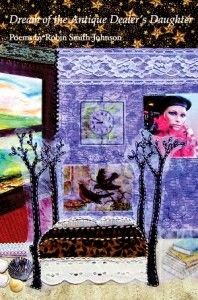
After this careful reading, Liz decided to change her approach to how she would create the cover art. It would be done in mixed media collage, a genre she was not familiar with. She took on the project with a spirit of adventure and the joy of creating something new.

Finally, it was time for me to click on the link Liz had e-mailed to me. I was in my office at the Cape Cod Times when I looked for the first time at the beautiful cover she had created. I was overwhelmed with its beauty, power and originality. In Melanie Lauwers column “Cape Cod Book Scene,” she writes of my book: “Liz Smith’s intriguing cover hints at poems of nature and the past and the way human lives are stitched together.”

 The cover depicts a bed with trees for posts and vintage fabric stitched into a cozy coverlet. There are birds overhead and a clock depicting time passing. A map of Moldova and the photo (by brother Dell) of a mannequin. The open window shows a painting by my dad and a stack of books by the bed was painted by Liz’s mom, Marilyn. The cover art is intimate and personal to many of the poems in my book. It is everything I could have wanted and more.

To read Liz’s account of creating my cover, please check out her blog. http://madeinlowell.blogspot.com/2014/07/creating-cover-art-for-dream-of-antique.html.


I