Monday, April 14, 2014

Phone call during a spring blizzard leads to article


A few weeks ago, the Cape was visited by a late March blizzard. My class was cancelled and I decided to stay home from work. The winds were howling and snow was coming down sideways. It seemed a good day to stay inside. Although the lights flickered once or twice, we were fortunate not to lose our power. In the early afternoon, I noticed I had a Facebook message. The editor of the Mashpee Enterprise wrote to say one of his reporters wanted to speak to me about my recent third place win in the WOMR contest. Soon after, I had a twenty-minute phone interview with Lannan O’Brien. This article appeared in the Mashpee Enterprise on Friday, March 28.


Mashpee Resident Places Third in Outermost Poetry Contest
By Lannan M. O Brian

Mashpee resident Robin L. Smith-Johnson was pleasantly surprised when she learned that her poem placed third in the regional category for the WOMR/WFMR Outermost Poetry Contest, out of hundreds of entries from across the country.

“I received the press release at work and I looked at it, and it didn’t compute,” she said. “I said, “Oh, wow!””

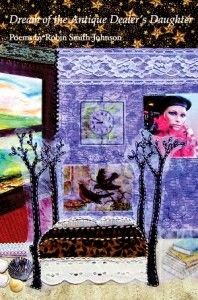
Ms. Smith-Johnson, a newsroom librarian for the Cape Cod Times and an adjunct professor of English at Cape Cod Community College, recently released a new book of poems titled, “Dream of the Antique Dealer’s Daughter,” with collage-style cover art by her sister-in-law, Liz Smith.

The book was launched at the Cultural Center of Cape Cod the same night that she received news of her award, and several other winners – Judith Partelow of Harwich, who won second place in the regional category; Lauren Wolk from Centerville, who earned an honorable mention, and Neil Silberblatt from Chatham, who was mentioned in the results as one of the “top poets” from Cape Cod – who happened to be in attendance were invited to read their award-winning poetry.

“It was amazing that everybody had their poems with them,” Ms. Smith-Johnson said.
Additionally, members of the Steeple Street Poets group that she leads with fellow English professor James Kershner at the Mashpee Public Library each read one of her poems and one of their own.

Ms. Smith-Johnson’s winning poem, titled, “A Dropped Stitch,” uses imagery of a woman knitting to depict isolation and death.

“I guess I’ve been working recently with thinking about isolation and how it affects people,” Ms. Smith-Johnson said. “Because I live in a family setting, I’m not isolated, but I guess I’m just interested in that.”

At the time, she was attracted to the theme of her subject knitting “threads of her life” because she was knitting herself and reading a book about knitting.

Unconsciously, Ms. Smith-Johnson said, her interest in death may have been partly inspired by her father’s death two years ago, for which only she was present. Through lines that describe “hoarse breathing” and “pulsing in the neck or wrist/until it too stopped” she recalls feeling  her own father’s pulse in his last moments of life.

The last stanza describes the woman gathering dropped stitches  only to drop them again. Finally she is instructed, “Never keep what won’t last.”

Although she has been a finalist in several other contests, including two others judged by writer Marge Piercy, the judge of the Outermost Poetry Contest, and one judged by poet Naomi Shihab Nye at the Cultural Center of Cape Cod, this was her first time winning a contest.
           
“I guess you do it (enter contests) for validation,” she said. “You want to see if you’re making progress.”

Moreover, she said that there is a community of writers and poets on the Cape who enter contests and encourage each other to do so.

When she was 9 or 10 years old, Smith-Johnson, who was raised by parents who were both writers, was inspired to write poetry when a teacher read William Blake’s “The Tyger” in class.

“It was one of the first times I thought, ‘I could do that..’” she said.

Ms. Smith-Johnson lives on Ships Anchor Drive off Mashpee Neck Road with her husband, Gregory R. Johnson, and her son, Ross.

Saturday, April 5, 2014

Mutual Muses: “Angel of Cape Cod”


I love the phrase ‘Mutual Muses’ – it denotes a shared creation and the exhibit/poetry reading last night perfectly captured that idea. The artist who received my poem “The Season When” created a huge painting of spring flowers in a vase. By contrast, I wrote a poem titled “Angel of Cape Cod” for Carole Johnson’ delicate pendant.

Often when I begin to draft a poem, I have little idea what the finished product will be. I might have an image or brief narrative in mind. Working with a visual picture gives the poet focus. For the past few months, I have studied the angel-looking pendant as its picture graced the piano in our living room. Lauren Wolk, associate director for the center,  had told me last November that the name for the piece was “Angel of Cape Cod” so I took that for my theme.

I knew I didn’t want some ethereal, floaty depiction of an angel, but something more earthly and evocative of the Cape. In my poem, I addressed my angel like this: “Oh, barnacled one, with gull feathers for wings,/skate egg cases as eyes,/seaweed dangling – a bedraggled gown.” My husband, Greg, thought my description was creepy but I liked its raw, sea-inspired tone. Later in the poem, I wrote: “Shy soul adrift in the waves/you float over blue harbors/kettle ponds and salt water bays./Birds trail in your wake, their cree cree/signalling your earthbound work.” When the angel is called back, there is “only mist as it rises/over open waters.” I wanted to capture power and healing, presence and absence.

Now, it was time to share this new poem with a hundred people! I think it was a good omen that the very first creature I saw on entering the Cultural Center last night was the resident cat sitting by the front steps. I almost think she gave me a wink as I entered the large, noisy room brimming over with expectant people looking for their friends.  During the reading, I anxiously awaited my turn. Since the poets are called up in alphabetical order, I was one of the last to read. I sat clutching my poem and my reading glasses as I waited. When my name was called, I tried to remember to slow down my reading. I realized it’s easier to read a familiar poem rather than a brand new one. Still, there was a nice roar of applause when I sat down. It was a magical night and wonderful to share with so many local poets and artists.

In the next few weeks, I hope to travel once again to the Cultural Center to take a quiet hour or two to study the pairings of artwork and poetry. Perhaps I’ll take a friend or family member to share the experience with. It’s a nice way to absorb the experience and feed my creative spirit.
(http://cultural-center.org/)

Friday, March 21, 2014

Writing Prompt #2

Writing Prompt #2


One of the many joys of being in a poetry group is sharing and exploring different ways of writing poems. Last October, James Kershner, leader of a Buddhist Sangha on Cape Cod and co-founder of the Steeple Street Poets, led us on a haiku walk. Our group meets at the Mashpee Public Library near Christ the King Church with its lofty steeple, thus our name and the street the library is on (Steeple St.)

Before we went outside, James asked us to walk in silence. Our group of about ten poets spent a quiet ten or fifteen minutes walking in the park area opposite the library. On our return, we composed our haiku in silence. I wrote: “Hearse pulled up to curb/white church steeple overhead/our silence a prayer.”  The traditional haiku is three lines with five/seven/five syllables. In more contemporary poetry, haiku is often written in anywhere from eight to thirteen syllables, usually with a nature theme.

Next, James had us try an experiment. We would do some free writing, then meditate for a few minutes, and write some more. One short piece I wrote prior to meditating: “Vintage buttons in a jar/fireflies of the past winking.”  As we quieted our minds and our breathing, James asked us to imagine the air we breathe in connecting us. After I opened my eyes, I tried writing again. I think this later writing was more expressive: “Time flows backwards/nothing here but my heart.wanting waiting” and “Sign language/gestures of the heart/grown too big/explosion.”

The next part of this session involved each of us writing an alphabet poem. Some of the resulting poems were creative and intellectual. I chose to write about animals: “Adder’s sting/bee’s breath/cats slinking…” and ending with “venus fly trap/wasp worries/x-tra kibbles/young hatchlings/zookeeper’s dream.” It was fun to use my imagination in this poem.

Finally, James had us try a list poem. I chose to write about things I’ve discovered: “Even in an ordered life/the unexpected can happen” (philosophical) or “Dust bunnies = broken vacuum” (humorous).  All in all, it was a wonderful session and I came away with new ideas for creating poems. In future posts, I will offer more writing prompts and would also love to hear from readers of this blog. If you have a writing prompt that works to unleash your creative voice, please send it rosmithj@yahoo.com.


Monday, March 3, 2014

Writing Prompt #1

Sometimes when a poet encounters writer’s block, that inability to write or come up with ideas, a writing prompt can help open up the poetic floodgates. A simple definition might be “a writing prompt is basically a question which helps the writer move into action.” Writing prompts can also allow for experimentation or revision.

In our Mashpee poetry group, the Steeple Street Poets, we have a volunteer leader for each monthly session. Often, that leader chooses a theme for us to try. In recent months, we have looked at persona poems, haiku, six-line poems, etc.

In this post, I would like to examine one of our more successful writing prompts introduced by fellow poet Jarita Davis. She had asked us to bring in a poem and we would work on changing/transforming it. At the beginning of this workshop, she asked us to fold our poem in half. Now, she instructed, we would work with only one side of the poem showing. After a few questions, we busied ourselves with  Jarita’s novel concept.

The poem I brought to workshop, “Swept Up,” is about taking my college students for a walk. It begins “I broke with ritual today.” When I folded the poem in half, the right side looked something like this: “today/desk and notes/strolled green paths/sang/quietly.” Interestingly, there was still meaning in the words. Jarita explained this method helps you excise unwanted lines and words and still keep the integrity of the poem.

Next, she had us write the poem using opposite phrases. For example, my title became “Turned Down.” The phrase “newborn and blank” became “ancient and wise.” Again, this was a way to turn the poem upside down to yield surprises.

Finally, Jarita handed out scissors and glue sticks. We were instructed to cut up our poem into one or two line segments and glue the small sections to a clean sheet of paper. After studying these pieces of a longer poem, I came up with a completely new short poem called “Too Much Faith in Words.” It reads “I would be something fallen/newborn and blank./Between letters,/I would be the white space.”

Looking over my notes from that day’s session, I could probably find even more poems. It was a great exercise and one I want to try again soon. So, stay tuned! In my next post, I will look at another inspiring writing prompt.

Monday, February 17, 2014

Book Launch

On Thursday evening, Feb. 13, I traveled with my family to the Cultural Center of Cape Cod for a magical evening of poetry and music. My husband, Greg, along with fellow musicians, Dinah Mellin and Denya LeVine, played as friends and poetry supporters gathered for the reading. The venue was a beautiful one with rooms filled with art and even a retired bank vault that was transformed into an indoor woodland scene, complete with twigs and branches. Folks sat at round tables and there were plenty of refreshments to go around.

The evening continued with members of the Steeple Street Poets reading one of my poems and one of their own poems. I enjoyed hearing my poems interpreted by my fellow poets, each in an original voice. When it was my turn to read, I stepped up to the podium and looked out at the crowd. My nerves melted away and I began to read. I was especially glad to see my sister, Cindy, sitting with my sons Ross and Devin. For twenty minutes, I chose poems that spoke to my heart and, hopefully, resonated with the people listening attentively in front of me. My poem “Gretel’s Complaint” met with some laughter at the end, so I was happy my audience was staying with me.

Afterwards, I introduced several poets who had just that day found out they were winners in the WOMR Outermost Poetry Contest. We heard from Judith Partelow, Lauren Wolk and Neil Silberblatt. Although I didn’t read my winning poem, I was happy to know I had won third prize in the contest (judged by Marge Piercy).

After the reading, people mingled, drank wine or sparkling water, and sought me out for a few words of greeting and congratulations. I also sold and signed some books. Although the night was rainy, windy and foggy, I was happy that my friends and family members had ventured out to share this special evening. Even the resident cat seemed to enjoy the festivities. It was truly a night to remember! 

Tuesday, February 11, 2014

My First Interview

Interview with Poet Robin Smith-Johnson by Dell Smith (from Beyond the Margins website:
http://beyondthemargins.com/2014/02/interview-with-poet-robin-smith-johnson)

I was raised in a house full of books and writing. My parents wrote novels and kept journals, and so it was natural that my three sisters became writers as well.
My sister, Robin Smith-Johnson, has been writing and publishing poems for years in journals like The Aurorean, The Larcom Review, Sandscript, and Yankee Magazine, and has just published her first collection called Dream of the Antique Dealer’s Daughter. Robin’s writing is informed by her life on Cape Cod, her family, and growing up as the daughter of parents who collected and sold antiques and rare books.
Robin Smith-Johnson sits down with BTM (and her brother) to discuss how she approached structuring her poems into a book, balancing a busy home, work, and writing life, and her influences.
Dell Smith: Congratulations on Dream of the Antique Dealer’s Daughter.  I found reading this collection emotional and very rewarding. You blend lyricism and naturalism seamlessly. Many of your poems include striking descriptions of nature, landscapes, and atmosphere. Does this infusion of the natural world come from living on Cape Cod, historically a naturalists’ paradise? How much did our father, who painted Cape Cod landscapes and wrote about nature, inspire you?
Robin Smith-Johnson: I think growing up on Cape Cod influenced my poetry and my way of looking at the world. It is a rare opportunity to live in a place surrounded by water. I have always loved walking the local shorelines and this is a theme running through my poems. For example, my poem “My Son at Four, Walking the Beach” describes my young son collecting shells. “No one had to show him/the art of discerning/one from another:/conch, razor, slipper shell.” I also think Dad’s love for painting Cape landscapes was a subconscious influence as well. We always had his paintings scattered around the house. It seemed natural to express myself artistically because I had artistic parents.
DS: The antique dealer of the title is our mother, who began collecting and selling antiques when we were all very young. How did our mother and her antiques inspire you?
RSJ: Some of my favorite memories are working in the Incredible Barn (the antique shop our parents owned on Cape Cod) and seeing all the wonderful, whimsical things our parents would bring home from their many antique buying trips. In my poem “Discovery, One Spring Morning,” I paint a portrait in words of an old sculpted head that Mom had in her shop for years. “Over my head/I see the face, perfect like a lily,/singular and white, staring from the shadows.” Also, the title poem – Dream of the Antique Dealer’s Daughter” – tells the story of my relationship with a mannequin in our shop. A local artist, Robert Vickrey, eventually bought her to act as a kind of scarecrow to scare the ducks from his dock on Crystal Lake in Orleans. “At twelve, we wore the same size./Faded skirts, lace dresses,/old petticoats.” It really was a charmed childhood and I wouldn’t have traded it.
DS: How would you describe your poetry? Autobiographical? Fiction? Or is poetry in general a combination of the two?
RSJ: That‘s a tough question! I think many of my poems are autobiographical or slightly disguised fiction. Of course, some are from my imagination; for example, I include some of my fairy tale poems in the section “Once Upon a Time.” Lee Roscoe, in her review of my book in the Barnstable Patriot wrote, “These days poetry often serves autobiography, and has to be judged as such, rather than as poetry per se. Robin Smith-Johnson’s well-constructed poems are a memoire. She travels through youthful nightmares, to adulthood, the external world, and even the next world, in seven sections …” So, yes,  I definitely think many of my poems are personal and explore themes that relate to my life.
DS: In your book you break the poems down into thematic sections, including a series of poems based on fairy tales and a section focusing on your three sons. How did you approach this structure?
RSJ: When I first decided to put together a collection of my poems, I found that not much had been written on the subject. Michael Bugeja, in his book Poet’s Guide, has a chapter on “Assembling chapbooks and books” that was helpful. I also studied books by other poets to give me a feel for how poetry books are constructed. Since my poems span thirty years, I decided to have a somewhat chronological organization; therefore, I cover poems of my childhood, love and relationships, my children and life as a mother, travel poems, nature poems, etc. I couldn’t leave out my fairy tale poems, so I placed them after the section about children. The last part  is a miscellany of poems that didn’t fall naturally into any of the other sections. My friend and poetry mentor, Sheila Whitehouse, has a wonderful collection called Flint and Needle. She used lines from her poems to use as titles for her sections, so I did the same in my book.
DS: You play piano in a couple of bands on the Cape. How do you compare playing music to writing, and does one creative outlet feed the other?
RSJ: Playing in a band is a highly social, collaborative, and even athletic endeavor. When I play rhythm keyboard with Polka Dan’s Beetbox Band, I’m using every ounce of energy in my body. I think writing poems is more cerebral and intuitive. And, writing is more solitary. The two artistic forms feed different parts of my psyche (one dramatic, one more inward). I love writing poetry, but I love playing music, too. The two art forms complement one another and enrich my life.
DS: You also write stories and novels. In your writing life, do you consider yourself primarily a poet? Did you always want to be a poet?
RSJ: I do consider myself as a poet first. I started writing poems at a very young age and always considered myself a poet. The young adult novel I’ve been working on for several years is more of a hobby. It may never be published but I enjoy stringing words together to tell a story. The act of writing poems is more like breathing. I have to do it to make sense of my life.
DS: You lead a busy life, teacher, musician, and you work as the reference librarian at the Cape Cod Times. Not to mention you raised three sons. When do you find time to write?
RSJ: I mostly write in spare moments. Many of my poems are written on my off days while sitting at the kitchen table. When I sit down with pen and paper, my body relaxes. I’m giving myself permission to write. Often, a poem will have been rattling around inside my head. Some poems come in a torrent. When my son, Neil, came home from his month’s trip to Moldova several years ago, he talked for two hours non-stop, then announced he was going to bed. There was no way I could go to sleep so I sat down and wrote the poem “Souvenirs from Moldova” which ends “the young man wakes/not knowing what country he is passing through/or when he can go home again.” I hadn’t planned to write that poem; instead, it found me.
DS: Who are your favorite writers?
RSJ: I grew up loving Emily Dickinson and Edna St. Vincent Millay. In college, I read Anne Sexton, Sylvia Plath, Robert Lowell, T.S. Eliot and W.B. Yeats. I also read A.R. Ammons, Denise Levertov and Carolyn Forche. Over the years, I’ve dipped into books by Linda Pastan, Jane Kenyon, Mary Oliver, Mark Doty and others. For fiction, I love the novels by the Bronte sisters (my all-time favorite book is Jane Eyre), Willa Cather and Rumer Godden.
DS: What would you say to a young poet just starting out? Or to an aspiring writer trying to decide which type of writing to try?
RSM: I think the best advice to a young poet or aspiring writer is to read widely. Peruse the shelves of a local library or bookstore. Ask friends for advice on good books and authors to read. Subscribe to literary journals and see what the current trends are. Find a poetry mentor to work with. Sign up for classes at a local college, join a poetry group or take advantage of the many writing conferences available. For example, the yearly Grub Street Conference in Boston is the Muse and the Marketplace. Then, experiment with writing. Keep a journal for ideas, quotes, lists of characters, etc. I think most writers find early on what they have an affinity for, but sometimes it expands their creative minds to try something different.
DS: I write fiction–short stories and novels. I read very little poetry (outside of yours of course). I know I should read everything, including poetry, but I have to admit I don’t always ‘get it.’ What advice can you give a struggling poetry reader?
RSJ: Dell, if you want to expand your poetic horizon, try going to websites that post a new poem each day. My favorites are Poetry Daily and Verse Daily. These sites feature the best contemporary poets and will give you a taste for different types of poems being published. I also visit Garrison Keillor’s Writer’s Almanac which features a daily poem, too. Try checking out the poetry section at Barnes & Noble or the library.
DS: The cover of the book works well to convey the themes of your poems. Full disclosure: my wife, your sister-in-law, Liz Smith, designed the cover. Liz says:  “I wanted a person picking up Robin’s book to get a feeling from the cover about what was inside, I wanted the cover to evoke an overall feeling that accurately represented the contents. A close reading would reveal the correlation between certain poems, lines of poetry to the various symbols used in the cover image, like a little treasure hunt, a puzzle solved.” Tell me a bit about that process of working with an artist to represent your work.
RSJ: When I read in my book contract that I could supply the cover art, I immediately thought of Liz. I approached her and she was very enthusiastic about doing this. I think her original idea was to work from an old photo of our parents’ antique shop, but after reading the collection, she came up with a collage form that incorporates themes and images from the book. The whole project took about three months since Liz was working in a form she hadn’t tried before. When I finally saw the finished cover art, I was astonished by its beauty and close attention to the themes in my book. It was a great collaborative process from start to finish.
DS: What’s next for you? Will there be a sequel to Dream of the Antique Dealer’s Daughter?
RSJ: I would love to try a chapbook next rather than another full-length book. And, who knows, maybe I’ll finish my young adult novel. For now, I’m enjoying being a first-time author.
DS: Robin, thanks for answering my questions! Good luck with your book.
ROBINpictureRobin Smith-Johnson grew up in Orleans, Massachusetts where she honed her love of reading and creative writing. She has degrees in English from Wheaton College in Norton, Massachusetts and Bowling Green State University in Ohio. Her poems have been published in various journals, including The Aurorean, CapeWomen, The Larcom Review, Sandscript, Voices International and Yankee Magazine. Currently, Robin works as the newsroom librarian at the Cape Cod Times and teaches at Cape Cod Community College. She is also a co-founder of the Steeple Street Poets of Cape Cod. Robin lives in Mashpee with her family. Dream of the Antique Dealer’s Daughter is published by Word Poetry press.
Robin previously wrote a guest post for Beyond the Margins called Becoming a Poet.

Saturday, January 25, 2014

Performing Your Work

 This business of being a poet often entails standing up in front of a room of people and reading your poems. Two weeks ago, I read with Calliope, a group devoted to giving local poets a chance to bring their work before an audience. Alice Kociemba, the tireless and enthusiastic director of the reading series at the West Falmouth Library, asked me last year if I wanted to take part after my book came out. It was a wonderful opportunity to give back to my readers.

Since my book was published last month, different people have been giving me thoughts on their favorites from Dream of the Antique Dealer’s Daughter. When I started preparing for my reading, I used their suggestions to help me choose the poems I would read for the Jan. 12 event. The experience made me think about what it takes to give a good reading.

First, be prepared. It helps to make selections that will vary the pace and mood of the reading as you go along. Since I was reading from my book, I decided to choose two or three poems from each section. With a twenty-minute time slot, I wasn’t able to read all my chosen poems, but I came close. I tried to pick poems that I thought would connect with my audience. For example, I always enjoy reading “Gretel’s Complaint,” one of my fairy tale poems. I also chose poems about my childhood to start the reading. The first poem I read, “Rolling Down,”  was time specific: “By mid-January, I long for an open door,/clear empty light,/the rustle of my kitchen curtain/and the green breeze off the porch.” It felt like a good opening. I ended my reading with another crowd pleaser: “Old Bones.” I wanted poems that my readers would connect with on a personal level.

 Next, practice, practice, practice. The day before my reading I read over the fifteen or so poems I had selected to read. My husband and son served as sounding boards and offered helpful advice.  One good suggestion was for me to slow down. I know I tend to rush my words, so I paid attention to my diction and delivery. I also noted places where I tended to trip over words. I tried out alternate poems on the chance I wanted to throw in surprises or found one poem more meaningful than another.

On the morning of my reading, I picked out an outfit that I hoped was stylish, but comfortable. I didn’t want spiked heels or long dresses to trip over. I also asked a fellow poet for a ride since our one car wasn’t available for me to drive. It was nice to have a supportive friend by my side. We arrived early and that helped my case of nerves. The other two readers, Richard Hoffman and Kathleen Aguero, arrived a little later since they were driving from Cambridge. A married couple, they seemed very comfortable with the set-up.

I was asked to read first. Many poets don’t like to be the first readers, but I like getting my reading over with early so I can enjoy the rest of the event. I also think it helps to be flexible. Having given many readings in the past, it was a dream come true to have my book in front of me, rather than shuffling through papers. When it came my turn to read, I tried to clear my mind and focus on reading my poems.

So what can you do to make your reading a success? Be sure you are speaking into the mic and that everyone can hear you. Stand tall and make note of where your water bottle is. Reading is thirsty business. Most of all, enjoy the ride. The people shuffling in their chairs have given up their afternoon to hear you read, so keep them entertained and enlightened. Be natural and make eye contact with people in the audience. After all those solitary hours of writing, it’s nice to give back, to connect.